
Medical Clinic · Pratumnak Hill, Pattaya
SS-31 in Pattaya
Injection · Reviewed by a doctor first · Walk-in clinic

inside Thailand
★★★★★ 5.0 · 47 Google reviews · Walk-in clinic · Pratumnak Hill
Educational information. SS-31 is not offered as a product for healthy adults or normal aging. Any therapy is individualized, physician-supervised and reserved for appropriate medical indications. Always consult a doctor.
SS-31 (elamipretide) is a mitochondria-targeted tetrapeptide. It concentrates on the inner mitochondrial membrane and binds cardiolipin — the lipid that organizes the folded cristae where cellular energy is made — helping stabilize that structure and support ATP production. Its FDA approval is narrow (Barth syndrome); broader mitochondrial or anti-aging use is off-label and investigational. At our Peptide Department walk-in clinic on Pratumnak Hill, Pattaya, every case is reviewed by a doctor first. Ask our medical team via WhatsApp in around two minutes.
Dedicated Department
Peptide Department with its own protocols and follow-up structure.
Pharmacy-Verified
Compounded under licensed Bangkok pharmacy, COA-certified.
Evidence-Based
Every claim on this page links to its primary research source.
Lab-Verified
Every batch prepared by a licensed Thai compounding pharmacy with documentation.
Walk-in clinic · Pattaya
Start this week at our Pattaya clinic

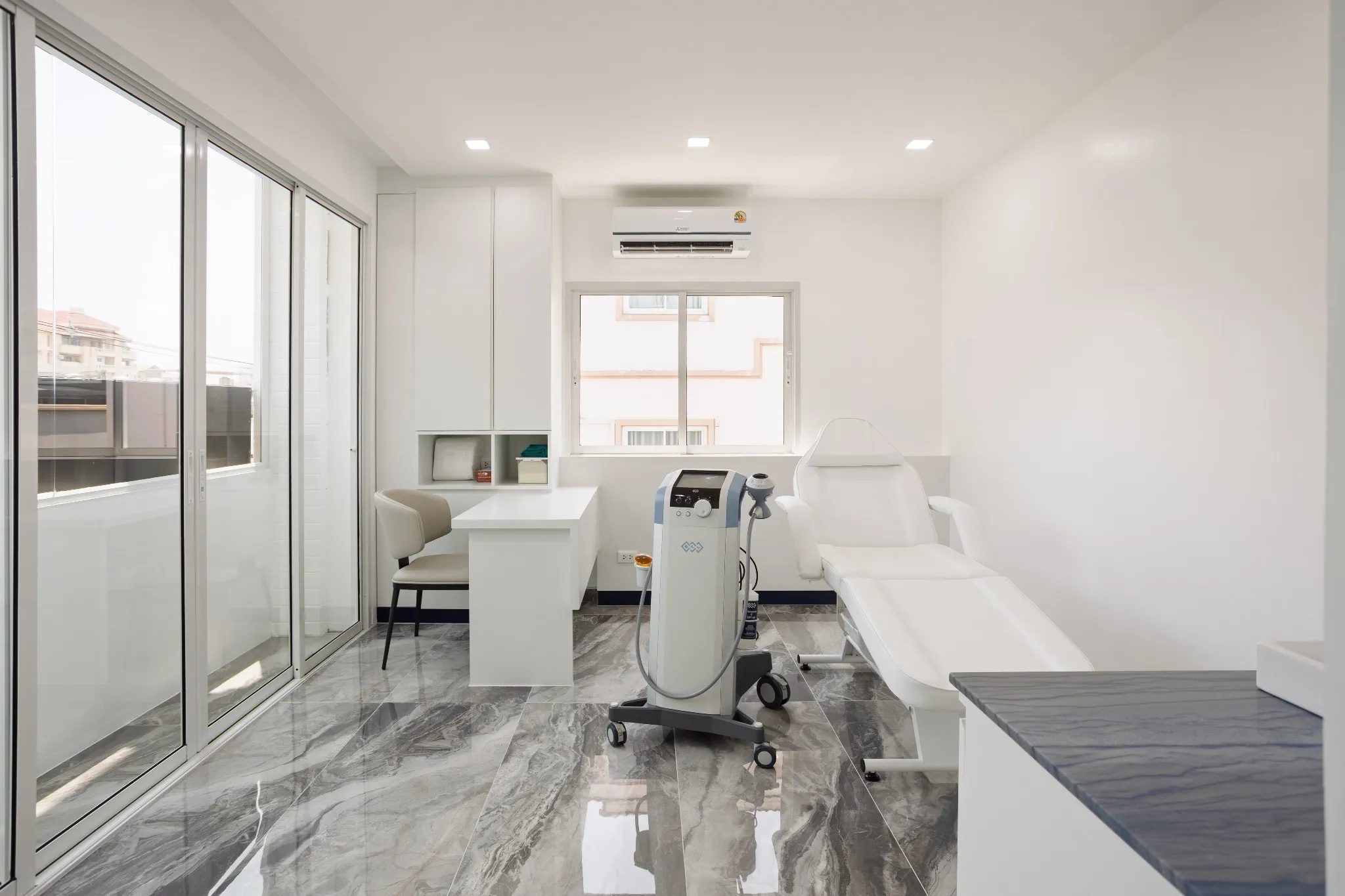

In person or online
Real doctor time, your way
Visit our Pattaya clinic in person, or book an online consultation from anywhere in Thailand — the same physician-led care either way.
Serving all Pattaya
Central Pattaya to Jomtien & Chonburi
In-person patients come to us from Central Pattaya, Jomtien, Naklua, Pratumnak and across greater Chonburi — and we consult online nationwide.
For travellers
Travel certificate available
Travelling with a prescribed therapy? We can provide a medical certificate to support your journey.
No referral needed. Visit our Pattaya clinic for a consultation and an honest, physician-led assessment. SS-31 at TRT Bangkok is provided through a dedicated Peptide Department with its own protocols, communication system and follow-up structure.
- 📍 389/203 Moo 12, Bang Lamung, Pattaya, Chon Buri 20150 · Pratumnak Hill, Soi 4
- 🕛 Mon–Sat · 8:00 am – 6:00 pm (Bangkok time)
- 💬 WhatsApp +66 84 224 9559 · LINE @trtbangkokclinic
- 🧪 Initial consultation, vitals and an honest suitability review in-house
Outside Pattaya?
Not in Pattaya? Book an online consultation with our medical team — same honest, physician-led guidance, just by video.
Online consultation →The Science
How SS-31 works
SS-31 (elamipretide) is a mitochondria-targeted tetrapeptide. It concentrates on the inner mitochondrial membrane and binds cardiolipin — a lipid essential to the membrane’s folded cristae — helping stabilize that structure and support energy (ATP) production.
Mechanism 1
Cardiolipin binding
SS-31 selectively binds cardiolipin on the inner mitochondrial membrane; the SS-31/cardiolipin interaction protected mitochondria and re-energized them during ischemia (Birk et al., J Am Soc Nephrol, 2013 · PMID 23813215).
Mechanism 2
Cristae & ATP
By stabilizing cristae structure and limiting cardiolipin peroxidation, it supports the electron-transport chain and ATP synthesis — the basis for its study in mitochondrial dysfunction (Birk et al., 2013 · PMID 23813215).
Mechanism 3
Clinical data · Barth syndrome
In Barth syndrome — a genetic cardiolipin disorder — a randomized trial plus a 168-week open-label extension (TAZPOWER) evaluated elamipretide, which was well tolerated (Reid Thompson et al., Genet Med, 2024 · PMID 38602181).
Elamipretide received FDA accelerated approval only for Barth syndrome, a rare genetic disorder. Its use for general mitochondrial support, anti-aging or performance is off-label and investigational — we run it only as an eligibility-reviewed, physician-supervised program.
Every mechanism above is backed by peer-reviewed research — and every claim on this page links to its primary source.
What SS-31 Supports
Where SS-31 acts
SS-31 acts at one precise place — the inner mitochondrial membrane — where cardiolipin organizes the machinery of cellular energy. Its human approval is narrow (Barth syndrome); broader use is investigational.
Target
Mitochondrial cristae
Binds cardiolipin to help stabilize the folded inner-membrane structure where ATP is made.
Approved use
Barth syndrome only
FDA accelerated approval is limited to this rare genetic cardiolipin disorder — not general anti-aging.
Access
Doctor-reviewed first
Eligibility review first; no self-prescribing and no published fixed dose — and honest about off-label status.
Every SS-31 program at our Pattaya Peptide Department is physician-supervised and framed by what the research does — and does not — support.
Regulatory status & safety
Where SS-31 stands — and who it isn’t for
Approval status
Is SS-31 an approved medicine?
SS-31 (elamipretide) is an investigational mitochondria-targeted peptide being studied in formal clinical trials (for example in mitochondrial disease). It is not an approved medicine, so outside a trial any use is experimental and should only be considered with full medical oversight.
A key caution
Who should be careful
As an investigational compound, its long-term safety in general use is not established; the honest position is that evidence is early and enthusiasm should be measured.
Generally not appropriate in: pregnancy, anyone expecting a proven anti-aging effect.
What a clinician monitors
Sensible checks before & during use
- Baseline review
- Close symptom monitoring given investigational status
Honest about side effects
Possible side effects
- Injection-site reactions
- Investigational — long-term safety not established
- Effects still being characterized in trials
This is why SS-31 belongs in a physician-led conversation, not an off-the-shelf purchase — honest risk disclosure and the right monitoring are part of using it responsibly.
Medically reviewed by the TRT Bangkok Peptide Department · a licensed medical clinic in Pattaya, Thailand. Last reviewed August 2026. Every clinical claim on this page links to its primary research source.
Compare the options
Longevity & cellular peptides at a glance
How SS-31 compares with the other cellular/longevity peptides people ask about — including how early or established the evidence really is.
| Peptide | Class | Pattern / half-life | Studied for | Approval |
|---|---|---|---|---|
| SS-31 (elamipretide) | Mitochondria-targeted peptide | Protects mitochondrial membranes | Mitochondrial function (trials) | Investigational |
| MOTS-c | Mitochondrial-derived peptide | Metabolic signalling | Metabolism (early research) | Not approved |
| Epithalon (epitalon) | Synthetic tetrapeptide | Pineal / telomere research | Cellular aging (older research) | Not approved |
| GHK-Cu | Copper tripeptide | Topical vs systemic differ | Skin, collagen, repair | Cosmetic ingredient (topical) |
Which (if any) is appropriate depends on your goal, your history and your labs — that’s the conversation to have with a doctor, not a decision to make from a table.
Quality & sourcing
Why source and purity matter with any peptide
This is one of the most overlooked parts of peptide safety. Much of what is sold online as “research” peptide is unregulated, and quality varies enormously. When something is going into a body, the source is not a detail — it is the whole point.
Identity & purity
Is it actually the peptide claimed, at the stated concentration — or under-dosed, mislabeled, or something else entirely?
Sterility
Was it produced and handled under conditions that are actually safe for injection?
Endotoxin contamination
Bacterial byproducts that can trigger fever and inflammatory reactions.
Heavy metals & impurities
Contaminants that have no place in anything you put into your body.
Storage & handling
Many peptides are fragile and temperature-sensitive; poor storage or shipping can degrade a product long before it is used.
Our position
If anything is ever appropriate for you, it is handled to medical standards from a quality-controlled source — and that decision is made with a doctor, not a checkout.
The safest way to answer “where should this come from?” is to bring the question to a clinician. We’re happy to talk it through — honestly, with no pressure.
How it works at our clinic
Information first, then a physician-led decision
See how every batch is checked
This is an educational page, not a checkout. We don’t sell SS-31 off the shelf. If it is clinically appropriate for you, any use is individualized and physician-supervised — here’s the path.
1
Understand the science
We explain what SS-31 does — and what the human evidence does and does not support — in plain language, with every claim linked to its source.
2
Consultation & assessment
A medical review of your goals and history — and, where relevant, testing. A doctor decides suitability, and will say so honestly if a better-evidenced option fits.
3
Supervised, if appropriate
Only if suitable: a protocol set individually and monitored. Doctor-reviewed first, no published one-size dosing, first administration guided at our Pattaya clinic.
There is no public price and no “order” button, by design: SS-31 is a medical matter, handled through consultation at a real, licensed Pattaya clinic.
Patient Reviews
from 48 verified Google reviews
Patients who choose our Peptide Department for SS-31 want a physician-supervised, honestly-framed program — not hype about anti-aging. Every vial is physician-supervised and grounded in the evidence; these ratings come live from our Google Business Profile and are refreshed regularly.
Verified patients
Real Google reviews
Updated regularly
Straight from our profile
Walk-in clinic
Pratumnak Hill, Pattaya
The research behind SS-31
The evidence behind SS-31
SS-31 has a clear molecular mechanism and an active clinical-trial history — with a narrow human approval (Barth syndrome) and investigational status elsewhere. We present both.
Mechanism
Birk AV, et al. J Am Soc Nephrol, 2013 · PMID 23813215
Showed SS-31 re-energizes ischemic mitochondria by binding cardiolipin and protecting the membrane — the foundational mechanism. PubMed
Clinical · Barth syndrome
Reid Thompson W, et al. Genet Med, 2024 · PMID 38602181
TAZPOWER: a randomized, placebo-controlled trial plus a 168-week open-label extension of elamipretide in Barth syndrome, reporting long-term tolerability. PubMed
Regulatory status
Approved for Barth syndrome only
Elamipretide received FDA accelerated approval specifically for Barth syndrome. For general mitochondrial support or anti-aging it is off-label and investigational.
Honest note
Mixed results outside Barth
Trials in other settings (e.g., primary mitochondrial myopathy) showed mixed results. We provide SS-31 as an doctor-reviewed option after an eligibility review, not a proven anti-aging therapy.
Each citation links to the peer-reviewed source for the mechanism described above.
Frequently Asked
SS-31 in Pattaya — common questions
What is SS-31 (elamipretide)?
SS-31 is a mitochondria-targeted tetrapeptide that binds cardiolipin on the inner mitochondrial membrane to help stabilize cristae and support ATP production. It is studied for mitochondrial dysfunction.
Is SS-31 FDA-approved?
Elamipretide received FDA accelerated approval specifically for Barth syndrome, a rare genetic disorder. For general mitochondrial support, anti-aging or performance it is off-label and investigational.
Does it work for anti-aging or energy?
That is not established. The strong evidence is mechanistic and in Barth syndrome; trials in other settings were mixed. We provide it as an doctor-reviewed option after an eligibility review, not a proven anti-aging therapy.
How is it given at TRT Bangkok Pattaya?
A small injection under the skin, only after a doctor’s review. We don’t publish fixed dosing; your first injection is demonstrated at our Pattaya clinic. Always consult a doctor.
What are the side effects, and who should not use SS-31?
In clinical trials the most common side effect was injection-site reactions (redness, itching or pain); headache and dizziness were also reported. It is not used during pregnancy without specialist advice. The doctor reviews this before anything is prescribed.
How is it different from MOTS-C?
Both relate to mitochondria, but differently: SS-31 targets the inner-membrane cardiolipin/cristae; MOTS-C is a mitochondrial-derived peptide studied in metabolic signalling. Which (if either) fits is a physician decision.
How do you assure quality and safety?
Every vial is prepared through a licensed Thai compounding pharmacy. Explore more on our peptide therapy hub.
How We Verify · Where To Find Us
Real verification, a real clinic in Pattaya
How we verify what you receive
Product is prepared by our licensed compounding pharmacy to medical standards — verified at the point of dispense, not from an anonymous online seller.
Licensed medical facility
Chon Buri, Thailand. Open Monday–Saturday, 8:00 am – 6:00 pm.
★★★★★ 5.0 from 47 verified Google reviews · Read them on Google
389/203 Moo 12, Bang Lamung, Pattaya, Chon Buri 20150 · Pratumnak Hill, Soi 4 · +66 84 224 9559
Other peptides we offer at TRT Bangkok
Our Peptide Department covers the full clinical-research spectrum — recovery, growth-hormone support, skin and longevity, libido and visceral fat.
SS-31 at TRT Bangkok is provided through a dedicated Peptide Department under the TRT Bangkok umbrella. This department has its own protocols, communication system and follow-up structure. Compounded under licensed Bangkok pharmacy · independent peptide protocols · eligibility-reviewed. All claims subject to current Thai regulations · individual eligibility. References available on request. Not for use during pregnancy. Individual results vary.
SS-31 in Pattaya — background and local access
SS-31 (also studied under the name elamipretide) is a peptide designed to target the mitochondria — the parts of the cell that generate energy. It has attracted research attention specifically because it concentrates at the inner mitochondrial membrane, and it has been the subject of formal clinical investigation for several mitochondria-related conditions. That places it somewhat differently from many peptides sold online: it has a real clinical research history, but it is still investigational rather than a routinely approved treatment.
Honest framing therefore cuts both ways. SS-31 is more than internet folklore, but it is not an established, approved medicine to be used casually, and it is certainly not a supplement. In a responsible setting it is handled only after an eligibility review, with expectations tied to what the evidence actually supports.
In Pattaya, the practical question is the same one that applies across this category: can the material be trusted, and has it been kept correctly? A 2–8 °C cold chain and documented identity and purity — confirmed by laboratory methods such as HPLC and mass spectrometry — separate a verified source from the unlabelled vials common in the grey market. With a peptide that has genuine research interest, that difference in quality is worth taking seriously.
Our clinic on Pratumnak Hill is there so the real questions — the state of the evidence, how the material is verified, and how eligibility is reviewed — can be discussed in person or over WhatsApp. Nothing on this page is medical advice, and no protocol begins without an appropriate eligibility check. The aim is an accurate, honest starting point for understanding SS-31 in Pattaya.